How UAE Contact Centers Are Using Predictive Routing to Serve a Multilingual, Multicultural Customer Base

Insights / How UAE Contact Centers Are Using Predictive Routing to Serve a Multilingual, Multicultural Customer Base

Contact centre predictive routing

The UAE's Multilingual Challenge

A single contact-centre queue in the UAE can carry a Gulf-Arabic-speaking Emirati, an English-speaking expatriate, a Hindi- or Tagalog-speaking resident, and a Levantine-Arabic caller, back to back. Generic round-robin routing serves none of them well.

Multilingual Contact Centre
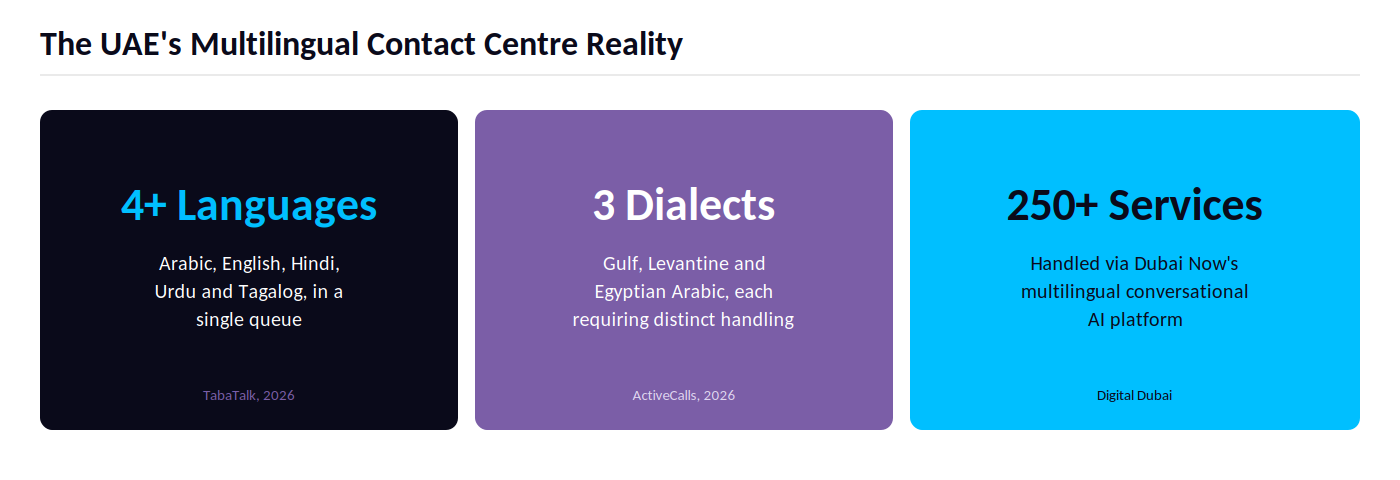
  • English and Arabic form the baseline expectation, though many centres also serve Hindi, Urdu, and Tagalog callers as standard, according to TabaTalk.
  • Arabic itself spans distinct dialect families — Gulf, Levantine, and Egyptian — each of which calls for different handling, per ActiveCalls.
  • Dubai Now alone handles more than 250 government and private-sector services via multilingual conversational AI, reflecting how central this capability has become to public-sector CX in the UAE.
  • The UAE National AI Strategy 2031 anchors continued government investment in this area, positioning multilingual, AI-driven customer experience as a national priority rather than a departmental initiative.
  • A frustrated caller reaching a generic queue may be a VIP banking, government, or major enterprise account and a poorly routed call from this segment carries disproportionate commercial and reputational risk, per ActiveCalls.
  • What Predictive Routing Actually Is
  • The Signals Predictive Routing Reads
  • The UAE Dimension
  • Building It — And How to Start
  • Predictive Routing Across UAE Industries
  • Measuring Predictive Routing Success
  • FAQs

What Predictive Routing Actually Is

Predictive routing uses machine learning to match each caller to the best-fit agent based on language, intent, sentiment, history, and customer value; evaluated together, in real time, rather than through a single static rule.

MethodHow it decidesLimitation
Round-robin / ACDNext available agentIgnores language, skill and history
Skill-basedPre-tagged agent skillsStatic; cannot read live context or sentiment
Predictive routingML matches caller to best-fit agent using language, intent, sentiment, history and valueRequires unified data and clean models

The practical difference against older methods is not marginal. Round-robin and skill-based routing both operate on information gathered before the call began; predictive routing incorporates what is happening in the call itself, including shifts in tone that neither of the other methods can detect.

The Signals Predictive Routing Reads

Language and culture signals:

  • Detected language and dialect — Gulf, Levantine, or Egyptian Arabic, or English, Hindi, or Tagalog routed to a matching agent.
  • Preferred-language history — the language a customer used in previous contacts, applied automatically to the current one.

Intent and context signals:

  • Reason for contact — IVR selection or NLP-detected intent (billing, complaint, new sale) routed to the correct queue.
  • Channel history — a prior WhatsApp or web-chat thread, so the caller is not required to repeat themselves.

Sentiment and value signals:

  • Real-time sentiment and frustration — an escalating tone routed directly to a senior agent rather than the next available one.
  • Customer value and segment — VIP banking, government-related, or enterprise accounts flagged for white-glove handling.

These signals are designed to stack: a Gulf-Arabic-speaking VIP caller with rising frustration and an open complaint should reach a senior, Arabic-speaking, complaints-trained agent in a single routing decision, rather than after two or three transfers.

The UAE Dimension

  • PDPL sets the rules. Federal Decree-Law No. 45 of 2021 governs the personal data of UAE residents with extraterritorial reach and defined data-subject rights. Routing that draws on customer history, voice recordings, or sentiment must rest on a valid lawful basis with clear purpose limitation. Commentators frequently cite penalties of up to AED 5 million for violations, though the PDPL’s implementing executive regulations have not yet published a fixed penalty schedule, organisations should treat this figure as indicative rather than confirmed until the regulations are issued.
  • Data residency and sovereignty are procurement questions. UAE organisations particularly in banking, government, and healthcare increasingly expect data to remain in-region, with cross-border transfer requiring an adequacy basis or standard contractual clauses. Where routing data and call recordings are hosted is a due-diligence item, not an afterthought.
  • Arabic-language disclosure is expected for consumer-facing services. This means routing and analytics providers must be able to transcribe and act on Arabic directly, not simply present a translated interface layer, per Almaazmi Lawyers.
  • Dialect-aware AI is non-negotiable. Routing models need to distinguish Gulf, Levantine, and Egyptian Arabic, and switch fluidly between Arabic and English mid-conversation; an English-only model is not viable in this market.
  • Free-zone regimes differ from onshore UAE. DIFC and ADGM each operate their own GDPR-aligned data regimes, meaning a bank in DIFC carries different obligations from an onshore retailer using the same routing platform.

Building It — And How to Start

  1. Unify the customer profile, stitching voice, WhatsApp, chat, and CRM history into one in-region, PDPL-aligned view per customer.
  2. Build dialect-aware language models covering Gulf, Levantine, and Egyptian Arabic alongside the key expatriate languages, with sentiment and intent detection built in.
  3. Define the routing logic, combining language, intent, sentiment, and value into a single best-fit decision rather than a sequence of separate checks.
  4. Pilot on one queue — a high-stakes segment such as VIP or complaints handling is the strongest starting point; measure FCR and CSAT, then scale.

Vendor data supports the direction of this shift:

  • Reduced handle time and fewer repeat contacts are associated with predictive routing, per ActiveCalls.
  • VIP or at-risk calls can be flagged within minutes rather than weeks, according to ActiveCalls.
  • ML-driven analytics improve staffing decisions and conversation quality, per Voiso’s analysis.
  • A unified ai agent workspace measurably reduces handling time by eliminating the need for customers to repeat themselves across transfers, according to TabaTalk.

The consistent operational gap across UAE contact centres is not any single capability listed above, most centres already have fragments of language detection, sentiment analysis, or CRM history somewhere in their stack. The gap is combining them into one routing decision, in-region, in the seconds before a call connects.

This is the specific problem Worktual’s Cognitive CDP and CCaaS layer are built to solve:

  • A hub-and-spoke architecture unifies voice, WhatsApp, web chat, and CRM history into a single customer profile hosted in a UAE-compliant environment, so language, sentiment, and account value are already resolved before the call reaches the routing decision.
  • An integrated NBA engine then makes that decision matching a Gulf-Arabic-speaking VIP caller to a senior, Arabic-speaking agent in one step, rather than reconstructing the match across separate systems mid-call.
  • Centres can track the outcome directly in FCR, average handle time, and CSAT segmented by language, rather than relying on an aggregate score that can mask a weak experience in any single dialect.

Predictive Routing Across UAE Industries

The same routing engine addresses a different problem in each of the UAE’s major service industries.

Banking & Financial Services

High-value and compliance-sensitive, often regulated under DIFC or ADGM. Predictive routing flags VIP and priority-banking callers for senior, in-language agents and keeps sensitive data in-region, a fraud alert from a frustrated Gulf-Arabic-speaking client should never sit in a generic queue.

Telecom

High volume and thin margins, with significant churn risk. Routing reads intent — billing, outage, or upgrade and sentiment to deflect simple queries to self-service or WhatsApp, while escalating at-risk, high-frustration callers directly to retention-trained agents.

Government & Public Services

The UAE leads the region on digital government, including Dubai Now’s 250-plus services. Citizens and residents expect service in their own language across Arabic dialects and expatriate languages; predictive, language-aware routing is what allows multilingual public-sector CX to function at national scale.

Travel, Hospitality & Retail

Tourist-heavy and WhatsApp-first. Routing stitches a prior chat or booking to the live call so the traveller does not repeat themselves, and matches language for a genuinely local welcome.

Measuring Predictive Routing Success

Multilingual Contact Centre Predictive Routing

Predictive routing is only worth adopting if the underlying numbers move. The relevant KPIs, tracked before and after a pilot, are:

  • First-contact resolution (FCR) — the headline metric; best-fit routing should lift it, particularly on in-language calls.
  • CSAT / NPS by language — segmented by Arabic dialect and expatriate language, to expose gaps an aggregate score would hide.
  • Average handle time (AHT) — fewer transfers and no repeated context should reduce this over time.
  • Transfer / escalation rate — a direct measure of routing accuracy; every avoidable transfer represents a routing miss.
  • Routing accuracy — the share of contacts reaching the best-fit agent on the first attempt.
  • VIP / at-risk flag time — how quickly high-value or high-frustration calls are identified and escalated.

The most reliable way to measure this is as a before-and-after loop: baseline these KPIs under the current routing method, pilot predictive routing on a single queue, then compare directly. Language-segmented reporting matters here specifically, an aggregate CSAT score can conceal a materially poorer experience in one Arabic dialect.

FAQs

1. What is predictive routing in a contact centre?

Predictive routing uses machine learning to match each caller to the best-fit agent based on language, intent, sentiment, history, and value. It evaluates these signals together in real time, rather than applying a single static rule.

2. How is predictive routing different from skill-based routing?

Skill-based routing relies on pre-tagged, static agent skills and cannot read live context. Predictive routing incorporates real-time sentiment and behaviour, adjusting the match as the interaction unfolds.

3. Why does predictive routing matter for UAE contact centres?

UAE queues routinely mix Gulf-Arabic, Levantine-Arabic, English, Hindi, and Tagalog speakers. Predictive routing is what allows a single queue to serve all of them accurately, rather than defaulting to the next available agent.

4. How does predictive routing handle Arabic dialects?

Dialect-aware language models distinguish Gulf, Levantine, and Egyptian Arabic and route accordingly, switching fluidly between Arabic and English within the same conversation. An English-only model cannot make this distinction.

5. Is AI-driven routing compliant with UAE data protection law?

It can be, provided it operates under a valid lawful basis and purpose limitation as required by the PDPL, with customer data hosted in-region. Cross-border data transfer requires an adequacy basis or standard contractual clauses.

6. What signals does predictive routing use to make decisions?

Language and dialect, contact intent, channel history, real-time sentiment, and customer value are the core signals. Predictive routing combines several of these into a single decision rather than acting on just one.

7. How do UAE contact centres start with predictive routing?

By unifying customer data into one in-region profile, building dialect-aware language models, and piloting on a single high-stakes queue such as VIP or complaints handling before scaling further.

Related Posts

Unified Intelligence AI for Automotive

Unified Intelligence AI for Automotive: Elevating Lead Conversion, Strengthening Service Retention, Enhancing Dealer Efficiency

Customer service expectations have changed significantly across digital channels. Customers now expect immediate responses, accurate resolutions, and seamless support experiences across chat, email, voice, messaging apps, and self-service platforms. At the same time, enterprises are handling growing ticket volumes while trying to reduce operational costs and improve service efficiency. Traditional ticket management systems often struggle because support operations remain dependent on manual workflows, disconnected tools, and repetitive processes that slow down issue resolution.

AI-Native Cognitive Data Platform for Retail

AI-Native Cognitive Data Platform for Retail: Solving Fragmented Customer Journeys, Cart Abandonment, and Inconsistent Personalisation

Customer service expectations have changed significantly across digital channels. Customers now expect immediate responses, accurate resolutions, and seamless support experiences across chat, email, voice, messaging apps, and self-service platforms. At the same time, enterprises are handling growing ticket volumes while trying to reduce operational costs and improve service efficiency. Traditional ticket management systems often struggle because support operations remain dependent on manual workflows, disconnected tools, and repetitive processes that slow down issue resolution.

Unified Intelligence for Technology

Unified Intelligence AI for Technology: Accelerating Product Adoption, Customer Retention, Expansion Revenue

Customer service expectations have changed significantly across digital channels. Customers now expect immediate responses, accurate resolutions, and seamless support experiences across chat, email, voice, messaging apps, and self-service platforms. At the same time, enterprises are handling growing ticket volumes while trying to reduce operational costs and improve service efficiency. Traditional ticket management systems often struggle because support operations remain dependent on manual workflows, disconnected tools, and repetitive processes that slow down issue resolution.