

AI-Native Cognitive Customer Data Platforms for Ecommerce: Improving Customer Retention, Purchase Intelligence, and Customer Lifetime Value
Insights / AI-Native Cognitive Customer Data Platforms for Ecommerce: Improving Customer Retention, Purchase Intelligence, and Customer Lifetime Value

Table of Contents
The UAE has emerged as one of the Middle East’s most digitally advanced ecommerce markets, driven by high smartphone adoption, strong digital connectivity, and consumers who expect seamless, personalised shopping experiences across every interaction. Customers discover products through ecommerce websites, marketplaces, social media, mobile applications, and messaging platforms before making purchasing decisions, making connected customer intelligence essential for delivering consistent engagement across every digital touchpoint.
As ecommerce businesses expand across multiple digital channels, success depends on more than increasing customer acquisition. Organisations must understand customer behaviour in real time, strengthen customer loyalty, increase repeat purchases, and maximise Customer Lifetime Value (CLV). Yet many businesses still struggle to connect customer interactions across multiple systems, limiting their ability to deliver personalised experiences and respond to customer intent effectively.
As a result, many ecommerce businesses struggle to answer:
- Which customers are most likely to make a purchase?
- Which customers are at risk of disengaging?
- What is the next best action to improve conversion and customer retention?
Improving ecommerce performance requires more than consolidating customer data into a single repository. Businesses need an intelligent Customer Data Platform (CDP) that continuously connects behavioural signals, transactional history, engagement activity, and customer interactions into a unified customer intelligence layer.
By recognising customer intent, identifying behavioural patterns, and recommending the next best action, a Cognitive CDP enables ecommerce businesses to move beyond historical reporting towards predictive, context-aware decision-making. The result is more personalised customer experiences, stronger customer loyalty, reduced cart abandonment, and a scalable foundation for sustainable ecommerce growth.
- What AI-Native Cognitive Customer Data Platforms Mean for Customer Intelligence and Ecommerce Growth
- Ecommerce Challenges Affecting Customer Retention, Personalisation, and Customer Lifetime Value
- Solutions Ecommerce Businesses Need to Improve Customer Retention and Lifecycle Performance
- Why Worktual Delivers Measurable ROI for Ecommerce Businesses in the UAE
- Why Worktual Stands Apart
- FAQs
What AI-Native Cognitive Customer Data Platforms Mean for Customer Intelligence and Ecommerce Growth
The UAE’s ecommerce landscape is defined by digitally connected consumers, high mobile adoption, and rising expectations for seamless online shopping experiences. Customers interact with brands across ecommerce websites, marketplaces, mobile applications, social media, messaging platforms, and loyalty programmes, expecting every interaction to be relevant, personalised, and consistent. Meeting these expectations requires more than collecting customer data; it requires continuously understanding customer behaviour and intent across every digital touchpoint.
An AI-Native Cognitive Customer Data Platform (CDP) transforms fragmented behavioural, transactional, and engagement data into a continuously evolving customer intelligence layer. Rather than relying on historical reports or static customer segments, it identifies buying intent, predicts future behaviour, and recommends the next best action, enabling ecommerce businesses to personalise engagement, strengthen customer relationships, and improve commercial performance.
Customer Intelligence: The questions every ecommerce business should be able to answer
| Business Question | AI-Native Cognitive CDP |
|---|---|
| Which customers are most likely to purchase? | Identifies buying intent using real-time behavioural signals. |
| Which customers are at risk of churning? | Predicts retention risks through AI-driven behavioural analysis. |
| Which products should be recommended next? | Identifies product affinity and cross-sell opportunities. |
| Who should receive each campaign? | Creates dynamic customer segments based on behaviour, engagement, and lifecycle stage. |
| Which customers deliver the highest Customer Lifetime Value (CLV)? | Continuously evaluates customer value and loyalty potential. |
| What action should happen next? | Recommends the next best action to improve engagement, conversion, or retention. |
As ecommerce continues to evolve across the UAE, businesses that can transform customer interactions into actionable intelligence will be better positioned to deliver personalised shopping experiences, improve marketing effectiveness, strengthen customer loyalty, increase Customer Lifetime Value (CLV), and drive sustainable ecommerce growth.
Ecommerce Challenges Affecting Customer Retention, Personalisation, and Customer Lifetime Value
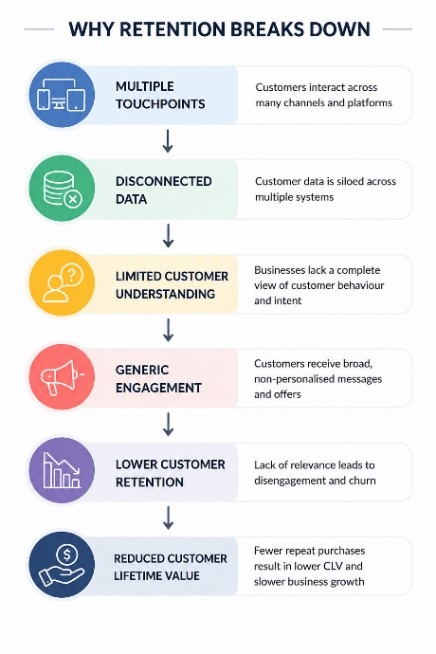
The UAE’s ecommerce customers expect fast, seamless, and personalised shopping experiences across every digital interaction. Whether discovering products through social media, browsing ecommerce websites, shopping via mobile applications, or engaging with customer support, they expect businesses to recognise their preferences and deliver consistent experiences throughout the customer journey.
Customer intelligence is often distributed across:
- Ecommerce platforms
- Customer Relationship Management (CRM) systems
- Marketing automation platforms
- Loyalty programmes
- Customer service applications
- Mobile commerce and messaging channels
Without a unified view of customer behaviour, businesses struggle to:
- Recognise buying intent in real time
- Deliver personalised customer experiences
- Maintain consistency across digital channels
- Increase repeat purchases and customer loyalty
- Optimise marketing performance
- Maximise Customer Lifetime Value (CLV)
The commercial impact extends beyond customer experience. Disconnected customer intelligence results in:
- Higher customer acquisition costs
- Lower repeat purchase rates
- Inefficient marketing investment
- Missed cross-sell and upsell opportunities
- Reduced customer loyalty
- Slower long-term revenue growth
Solutions Ecommerce Businesses Need to Improve Customer Retention and Lifecycle Performance
As the UAE’s ecommerce landscape continues to evolve, businesses need more than disconnected marketing, commerce, loyalty, and customer service applications. They need an intelligent customer platform that connects behavioural signals, transactional history, engagement activity, and lifecycle interactions into a unified customer view. This enables organisations to understand not only what customers have done, but also why they behave the way they do and how best to engage them next.
Worktual’s AI-Native Cognitive CDP brings together customer interactions across ecommerce platforms, marketplaces, mobile applications, marketing channels, loyalty programmes, and customer service into a single intelligence layer. By continuously analysing customer behaviour, Worktual helps ecommerce businesses identify buying intent, predict future actions, and deliver personalised engagement throughout the customer lifecycle.
With Worktual, ecommerce businesses can:
- Build unified customer profiles across every digital touchpoint
- Recognise buying intent and behavioural patterns in real time
- Deliver personalised customer journeys across multiple channels
- Trigger AI-driven engagement throughout the customer lifecycle
- Increase repeat purchases and strengthen customer loyalty
- Maximise Customer Lifetime Value (CLV) through intelligent lifecycle management
Rather than functioning as another standalone ecommerce application, Worktual acts as the intelligence layer that connects customer engagement, marketing, commerce, customer service, and loyalty into one coordinated ecosystem. This enables businesses to deliver consistent customer experiences, optimise marketing performance, improve operational efficiency, and drive measurable commercial growth.

Why Worktual Delivers Measurable ROI for Ecommerce Businesses in the UAE
In the UAE’s digitally connected ecommerce market, customer intelligence must translate into measurable business outcomes. As businesses compete across ecommerce platforms, marketplaces, mobile commerce, loyalty programmes, and digital engagement channels, success depends on delivering personalised experiences that improve conversion, strengthen customer loyalty, increase repeat purchases, and maximise Customer Lifetime Value (CLV).
Worktual combines an AI-Native Cognitive CDP with Customer Value Management (CVM) to help ecommerce businesses transform customer intelligence into measurable business value. By connecting behavioural insights with AI-driven engagement and lifecycle optimisation, Worktual enables organisations to identify buying intent, personalise customer interactions, and make faster, more informed business decisions across marketing, ecommerce, customer service, and loyalty operations.
Business Outcomes with Worktual
- Increase customer engagement and conversion
- Strengthen customer loyalty and repeat purchases
- Maximise Customer Lifetime Value (CLV)
- Optimise marketing investment through behavioural intelligence
- Deliver personalised customer experiences across every digital touchpoint
- Improve operational efficiency through AI-driven automation
- Drive sustainable revenue growth and long-term profitability
Unlike conventional customer data platforms that primarily support reporting and audience segmentation, Worktual operationalises customer intelligence across the ecommerce business. Its AI-Native Cognitive CDP for Retail continuously interprets customer behaviour, recommends the next best action, and helps businesses deliver relevant, personalised experiences throughout the customer lifecycle.
Worktual’s consultancy-led approach ensures that customer intelligence strategies align with each organisation’s commercial priorities, whether the objective is increasing revenue, strengthening customer loyalty, improving marketing performance, or optimising customer lifecycle engagement. The result is a connected intelligence platform that enables ecommerce businesses to build stronger customer relationships while delivering measurable commercial outcomes.
Conclusion
As ecommerce continues to evolve across the UAE’s digitally connected economy, competitive advantage will increasingly depend on how effectively businesses transform customer data into actionable intelligence. Organisations that invest in AI-native customer intelligence are better positioned to:
- Increase customer retention and repeat purchases
- Deliver personalised experiences across every digital customer touchpoint
- Recognise buying intent and recommend the next best action
- Improve marketing effectiveness and conversion rates
- Maximise CLV and long-term profitability
Worktual’s AI-Native Cognitive CDP helps ecommerce businesses transform fragmented customer interactions into connected intelligence by enabling organisations to:
- Unify behavioural, transactional, and engagement data
- Build a complete view of every customer across digital channels
- Deliver AI-driven personalised engagement in real time
- Strengthen customer loyalty and lifecycle performance
- Drive measurable business outcomes through intelligent decision-making
FAQs
1. What is a Cognitive Customer Data Platform (CDP)?
A Cognitive Customer Data Platform (CDP) connects customer data, behavioural signals, transactional activity, and engagement interactions into a continuously evolving intelligence layer. Unlike traditional customer data platforms that primarily consolidate information, a Cognitive CDP uses AI to interpret customer behaviour, identify buying intent, and support personalised engagement across ecommerce platforms, marketplaces, mobile applications, loyalty programmes, and digital commerce channels.
2. How is a Cognitive CDP different from a traditional CDP?
Traditional CDPs focus on consolidating customer data for reporting, audience segmentation, and campaign execution. A Cognitive CDP builds on this foundation by adding AI-driven intelligence, predictive analytics, behavioural insights, and next-best-action recommendations. Rather than simply storing customer information, it helps ecommerce businesses anticipate customer needs, improve decision-making, and optimise customer engagement throughout the customer lifecycle.
3. Why do ecommerce businesses need a Cognitive Customer Data Platform?
Ecommerce businesses in the UAE engage customers across ecommerce websites, marketplaces, mobile applications, loyalty programmes, customer service platforms, and digital marketing channels. A Cognitive CDP connects these interactions into a unified customer view, enabling businesses to deliver consistent, personalised experiences, strengthen customer retention, optimise marketing performance, and maximise Customer Lifetime Value (CLV).
4. How does a Cognitive Customer Data Platform create unified customer profiles?
A Cognitive CDP combines browsing behaviour, purchase history, loyalty activity, marketplace interactions, customer service conversations, transactional data, and engagement signals into a continuously updated customer profile. This enables ecommerce businesses to better understand customer intent, personalise customer experiences, and make more informed engagement decisions in real time.
5. Can a Cognitive Customer Data Platform help reduce cart abandonment?
Yes. A Cognitive CDP analyses behavioural signals, purchase intent, and engagement patterns throughout the buying journey. By enabling ecommerce businesses to deliver personalised reminders, contextual offers, product recommendations, and timely customer engagement, it helps recover abandoned carts, improve conversion rates, and reduce lost revenue.
6. How does AI improve ecommerce personalisation?
AI continuously analyses customer behaviour, purchase patterns, browsing history, product preferences, and engagement activity to identify trends and predict customer intent. This enables ecommerce businesses to deliver personalised recommendations, relevant offers, and context-aware shopping experiences that improve customer satisfaction, strengthen customer loyalty, and increase repeat purchases.
7. Why is omnichannel orchestration important in ecommerce?
Today’s customers interact with brands across ecommerce websites, marketplaces, mobile applications, social media, messaging platforms, email, and customer service channels before making a purchase. Omnichannel orchestration preserves customer context across these touchpoints, enabling ecommerce businesses to deliver seamless, personalised experiences that improve engagement, strengthen customer relationships, and increase customer retention.
8. How is Worktual different from standard ecommerce customer data platforms?
Worktual combines an AI-Native Cognitive Customer Data Platform with Customer Value Management (CVM), behavioural intelligence, and a consultancy-led approach to customer lifecycle optimisation. Rather than functioning as a static customer database, Worktual continuously interprets customer behaviour, predicts buying intent, and recommends the next best action. This enables ecommerce businesses to improve conversion, strengthen customer retention, maximise Customer Lifetime Value (CLV), and deliver measurable business outcomes through connected customer intelligence.

Related Posts

AI-Native Cognitive Data Platform for Retail: Solving Fragmented Customer Journeys, Cart Abandonment, and Inconsistent Personalisation
Customer service expectations have changed significantly across digital channels. Customers now expect immediate responses, accurate resolutions, and seamless support experiences across chat, email, voice, messaging apps, and self-service platforms. At the same time, enterprises are handling growing ticket volumes while trying to reduce operational costs and improve service efficiency. Traditional ticket management systems often struggle because support operations remain dependent on manual workflows, disconnected tools, and repetitive processes that slow down issue resolution.

What Is an AI CRM? AI-Native CRM Explained for UAE Businesses
A customer messages your business on WhatsApp about a delayed delivery. The chatbot creates a ticket but can’t resolve the issue.

Unified Intelligence AI for Technology: Accelerating Product Adoption, Customer Retention, Expansion Revenue
Customer service expectations have changed significantly across digital channels. Customers now expect immediate responses, accurate resolutions, and seamless support experiences across chat, email, voice, messaging apps, and self-service platforms. At the same time, enterprises are handling growing ticket volumes while trying to reduce operational costs and improve service efficiency. Traditional ticket management systems often struggle because support operations remain dependent on manual workflows, disconnected tools, and repetitive processes that slow down issue resolution.


